0945 418 118
  • Login
TNG Audio - Nhà phân phối Thiết bị âm thanh chuyên nghiệp, âm thanh hội nghị, âm thanh gia đình chính hãng
 
  • Register
  • Login

My cart

00đ
  • Your shopping cart is empty!

  • About us
  • Brand
    • Shure
      • Microphones Shure
        • Vocal microphones
        • Instrument Microphones
          • Piano Microphones
          • Electric Guitar & Bass Microphones
          • Drums & Percussion Microphones
          • String Instruments Microphones
          • Wind Instruments Microphones
        • Karaoke Microphones
        • MICROPHONE TYPES
          • Lavalier Microphones
          • Handheld Microphones
          • Gooseneck Microphones
          • Headset Microphones
          • Shotgun Microphones
          • Condenser Microphones
          • Dynamic Microphones
          • Ribbon Microphones
        • Camera Microphones
        • USB Microphones
      • Wireless Microphones
        • Axient Digital Series
        • ULX-D Series
        • ANX
        • QLX-D Series
        • SLX-D Series
        • MoveMic
        • BLX Series
        • SVX Series
        • Lavalier Microphone Wireless Systems
        • Handheld Microphone Wireless Systems
        • Headset Microphone Wireless Systems
      • Conferencing Solutions
        • Microflex Ecosystem
          • Loudspeaker
        • IntelliMix Room Kits
        • Stem Ecosystem
        • Microflex Wireless
        • Microflex Wired
        • Centraverse Series
        • Conferencing & Meeting Microphones
          • Hanging & Ceiling Microphones
          • Wall-Mount Microphones
          • Table Microphone
          • Array Microphones
          • Gooseneck Microphones
          • Boundary Microphones
        • ULX-D Series
        • Conference Speakers
      • Headphones
        • Headphones
        • Earphones
        • Headset
      • In-ear Monitoring Systems
        • Axient Digital PSM
        • PSM 1000
        • PSM 300
        • PSM 900
      • DSP, Routing & Mixing
        • Mixer
      • Networked Loudspeakers
      • Accessories
        • Antennas
        • Microphone Capsules
        • Microphone Stands & Mounts
          • Microphone Stands
          • Microphone Mounts
        • Audio Interfaces
        • Batteries & Chargers
        • Preamplifier
    • FOS Technologies
      • Moving Lights
        • Hybrid Lights
        • Beam lights
      • Mixers
      • Microphones
    • dBTechnologies
      • Active Speakers
      • Active Subwoofers
      • Active stage monitors
      • Line Array Systems
      • Passive Subwoofers
      • Column Systems
      • Others
    • ANT
      • Active Speakers
      • Active Subwoofers
      • Passive Speakers
      • Column Systems
      • Portable PA
      • Mixers
      • Wireless Microphone Systems
    • Behringer
      • Loudspeakers
      • Mixers
      • DJ Equipment
      • Wireless Microphones
      • Lighting
      • Controllers
      • Effects and Signal Processors
      • Accessories
    • Pioneer
      • A/V Component
      • Hi-Fi Components
      • Home Theater Systems
    • Onkyo
      • A/V Components
        • Network A/V Receiver
        • A/V Separates
        • Blue-ray, DVD players
      • Hi-Fi Components
        • Stereo Amplifiers and Receivers
        • Multi-Chanels Amply and Receiver
        • CD Players
      • Speakers
        • Front, Center, Surround Speakers
        • Subwoofers
        • Speaker Packages
      • System Components
        • Home Theater Packages
        • Compact Audio Systems
      • Headphones
        • Headphone
        • Earphones
    • Mission
      • Lx Series
      • Mx Series
      • Qx Series
      • Vx Series
      • Others
  • Applications
    • HOME AUDIO
      • Amplifiers
      • DVD/ CD Players
      • Home Speakers
      • Home Stereo System
      • Home Theater System
      • Karaoke Microphones
      • Receivers
    • STAGE AUDIO
      • Stage Microphones
        • Wired Live & Stage Microphones
          • Singer Microphones
          • Instrument Microphones
          • Clip-On Instrument Microphones
        • Wireless Microphones Systems for Live & Stage
      • Theater Microphones
        • Wired Microphones for Theatre
          • Musical Microphones
          • Speech Microphones
          • Instrument Microphones
        • Wireless Microphones Systems for Theatre
      • Broadcast
      • Location Sound Microphones
      • Mixer
      • Interview Microphones
      • Pro Speakers
    • CONFERENCING & MEETING
      • Home Office Microphones
      • Microphones For Speech
      • DSP & Network Interfaces
      • Mixer
    • STUDIO RECORDING
      • Studio Microphones
      • Studio Monitoring Headphones
    • CONTENT CREATION
      • Content Creator Microphones
        • Podcasting Microphones
        • Live Streaming Microphones
      • Live Streaming Headphones
      • Videography Microphones
      • Vlogging Microphones
      • Field recording microphones
      • Home Recording Microphones
      • Audio Interface - Soundcard
      • Mobile Microphones
    • CONFERENCING & MEETING MICROPHONES
      • Shure Microflex
      • Shure Microflex Microphones
    • PRO MICROPHONES
      • Ant Radiomics
      • Shure Microphones
    • HOME SPEAKER
      • Mission Speakers
      • Onkyo Speakers
    • STAGE SPEAKERS
      • Ant Speakers
      • dBTechnologies Speakers
    • AMPLIFIER & DVD/ CD PLAYERS
      • Onkyo Amplifiers
      • Onkyo DVD/ CD Players
      • Onkyo Receivers
    • MIXERS
      • Shure Mixer
      • Ant Mixer
    • HEADPHONES
      • Onkyo Headphones
      • Shure Headphones
  • News
    • PRO AUDIO
      • News
      • Case Studies
      • Knowledge
        • FAQ
      • Microphones
      • Wireless Microphones
    • CONFERENCE & MEETING AUDIO
      • News
      • Knowledge
        • Support
      • Case Studies
    • CONTENT CREATION
      • Knowledge
        • FAQ
      • News
    • HOME AUDIO
      • Knowledge
        • FAQ
        • Karaoke Knowledge
        • Hi-Fi Knowledge
      • News
  • Contact
  • Deals
Sign in Or Register
Forgot Your Password?

NEW HERE?

Registration is free and easy!

  • Faster checkout
  • Save multiple shipping addresses
  • View and track orders and more
Create an account
  • Home
  • Posts
  • Microphone Basics: Transducers, Polar Patterns, & Frequency Response

Microphone Basics: Transducers, Polar Patterns, & Frequency Response

Created Date: 25/Jul/2025
Microphone Basics: Transducers, Polar Patterns, & Frequency Response
It is important to understand a few basics that will aid in your selection and operation of the right mic for your application. The following article will cover what you need to know.


There is no such thing as a one size fits all microphone. If such a device were to exist, it would have to tick a lot of boxes; so many, that it would practically have to morph from one form to another. There are just too many variables in application to produce one unit that can deliver in every scenario. Therefore, in the absence of a magical microphone to rule them all, it is important to understand a few basics that will aid in your selection and operation of the right mic for your application. The following article will cover what you need to know.

There are 3 main technical points that are fundamental when it comes to microphone selection: 1. Transducer type, 2. Directionality (or polar pattern), and 3. Frequency response. These 3 things play a huge role in the sound and suitability of your microphone for any given application.

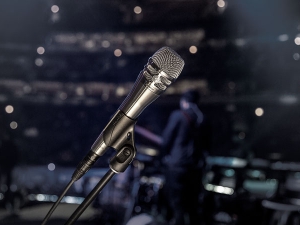
micro ca sĩ chuyên nghiệp Shure Nexadyne 8/C
Shure Nexadyne 8/C – dynamic microphone
 

Understanding Microphone Transducers

A microphone is essentially a transducer, which converts acoustic energy into electrical energy. The type of transducer is defined by the operating principle, with the two primary configurations being dynamic and the condenser mic elements.
 
Dynamic Microphones
Dynamic mics come in two distinct varieties: moving-coil and ribbon. Here's how they work:

Moving coil dynamic microphones are made up of a diaphragm, voice coil, and magnet that form a sound driven electrical generator. Essentially, as sound waves hit the diaphragm, the attached voice coil moves within the magnetic field to generate an electrical signal that corresponds to the original sound waves. This design makes for a very simple and robust microphone that can handle high sound pressure levels without distorting.
 
Dynamic microphone
 
Ribbon microphones are a variation on the dynamic microphone operating principle that consist of a thin piece of metal – typically corrugated aluminium – suspended between two magnetic pole pieces. As the piece of metal vibrates in response to a sound wave, the magnetic lines of force are broken – generating an electrical voltage. The output of ribbon microphones tends to be quite low and depending on the gain of your mixer or recording device, additional pre-amplification may be necessary.

It's important to note that ribbon microphones are less durable than moving-coil dynamic microphones. The ribbon element is typically no more than a few microns thick and can be deformed by a strong blast of air, or by blowing into the microphone. Also, phantom power applied to a ribbon microphone could be harmful.

Ribbon microphones are highly regarded in studio recording for their "warmth" and wide frequency response. Their advantage lies in the low mass of the ribbon, which enables better response to rapid transients thanks to less inertia. Ribbon microphones, therefore, have a more linear frequency response than moving-coil dynamic mics – making them a popular alternative to condenser microphones when a warmer tone is desirable.

 
Condenser Microphones
Condenser microphone elements use a conductive diaphragm and an electrically charged backplate to form a sound-sensitive capacitor. As the diaphragm vibrates in response to sound waves, the distance between the mic and backplate fluctuates within the electrical field to create the signal. In order to use this signal, all condensers have active electronic circuitry; often referred to as the 'preamp'. The inclusion of a preamp means that condenser microphones require phantom power or a battery to operate. (For a detailed explanation of phantom power, see our post.)
 
Condenser microphone
 
Condenser mic designs allow for smaller mic elements, higher sensitivity and a smooth response across a very wide frequency range. The main limitations of a condenser microphone relate to its electronics. These circuits can handle a specified maximum signal level from the condenser element; therefore, a condenser mic has a maximum sound level before its output starts to distort. Some condensers have switchable pads or attenuators between the element and the electronics to allow them to handle higher sound levels.
 

Directionality or Polar-Pattern

Directionality refers to the sensitivity relative to the direction or angle of sound arriving at the microphone. Directionality is usually plotted on a graph referred to as a polar pattern. A polar pattern graph shows the variation in sensitivity as you move 360 degrees around the microphone.

There are a number of different directional patterns available. The three most common patterns are omnidirectional, unidirectional, and bidirectional.


Omnidirectional microphones have equal response at all angles. Its coverage or pickup angle is a full 360 degrees, which comes with a number of distinct advantages or disadvantages depending on your application. On the positive side, omnidirectional mics have a very natural and open sound that is perfect for capturing organic sounds, such as an acoustic guitar. On the other hand, Omni mics pick up more room ambience, which can be desirable so long as you have great sounding room acoustics. In any case, the balance of direct and ambient sound can be controlled by varying the distance of the microphone from the instrument.
 
In a live scenario, omnidirectional microphones will leave you very susceptible to feedback; particularly when using stage monitors. To cut a long story short, if you want greater control of the sound entering your microphone, a unidirectional microphone is more likely to fit the bill.

Unidirectional microphones are most sensitive to sound arriving from one particular direction. The most common type is a cardioid (heart-shaped) response. This polar pattern has full sensitivity at 0 degrees (on-axis) and is least sensitive at 180 degrees (off-axis). Unidirectional microphones are used to isolate the desired on-axis sound from unwanted off-axis sound. To further emphasise this point, the cardioid mic picks up around one-third as much ambient sound as an Omni. By pointing the microphone directly at your desired sound source and away from the undesired room or ambient noise it is possible to reduce bleed significantly.

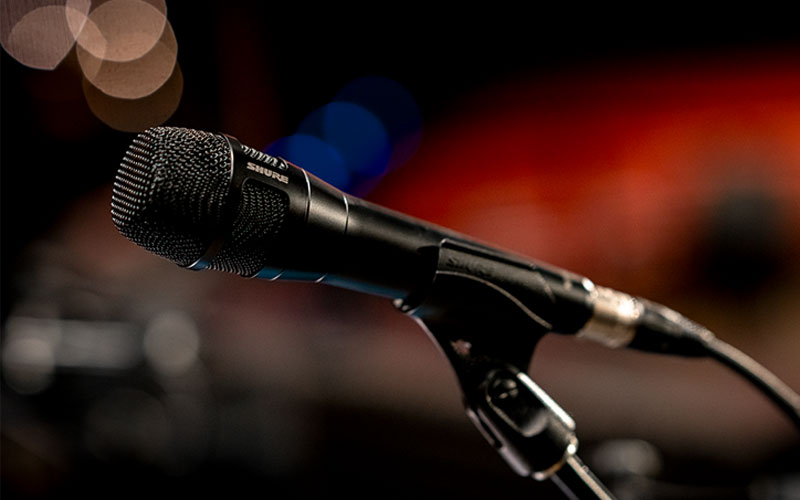
Micro condenser Shure KSM44A
KSM44A with switchable polar pattern


Other variants on the unidirectional polar pattern include supercardioid and hypercardioid options. Both patterns offer narrower front pickup angles than the cardioid – 115 degrees for the supercardioid and 105 degrees for the hypercardioid – alongside greater rejection of ambient sound. Additionally, while the cardioid is least sensitive at the rear (180 degrees off-axis), the supercardioid is least sensitive at 125 degrees and the hypercardioid at 110 degrees. When placed properly they can provide more 'focused' pickup than the cardioid pattern, but they also have less rejection at the rear. If you're using either of these polar patterns on stage with wedge monitors, it's important make sure you avoid placing the wedges directly behind the mic in this instance. Instead, place them either side at the mics least sensitive angle.

Bidirectional microphones have full response at both 0 degrees (front) and at 180 degrees (back). They are least sensitive at the sides. This mic can be used to your benefit when picking up two sound sources such as two vocalists facing each other; however, in most cases, it's typical just to use one side.


Other directional-related microphone characteristics:
Off-axis colouration – A microphone's frequency response may not be uniform at all angles. Typically, high frequencies are most affected, which may result in an unnatural sound for off-axis instruments or room ambience.

Proximity effect – For unidirectional microphone types, bass response increases as the microphone is moved closer to the sound source. When micing close with unidirectional microphones (less than 1 foot), be aware of proximity effect; it may help to roll off the bass until you obtain a more natural sound. You can 1. roll off low frequencies at the mixer, 2. use a microphone with a bass roll-off switch, or 3. use an omnidirectional microphone, which does not exhibit proximity effect.
 

Frequency Response

Last but not least is frequency response. This term refers to the variation in output level or sensitivity of a microphone over its useable range from lowest to the highest frequency.

Virtually all microphone manufacturers will list the frequency response of their microphones as a range, for example, 20 – 20,000Hz. This range is usually illustrated with a graph that indicates relative amplitude at each frequency. Two main categories apply here: 1) flat frequency responses and 2) shaped frequency responses.

A microphone with equal response at all frequencies is said to have a 'flat' frequency response. These microphones typically have a wide frequency range and tend to be used to reproduce sound sources without colouring the original source. These characteristics are desirable when capturing instruments such as acoustic guitars or pianos and for distant micing techniques.

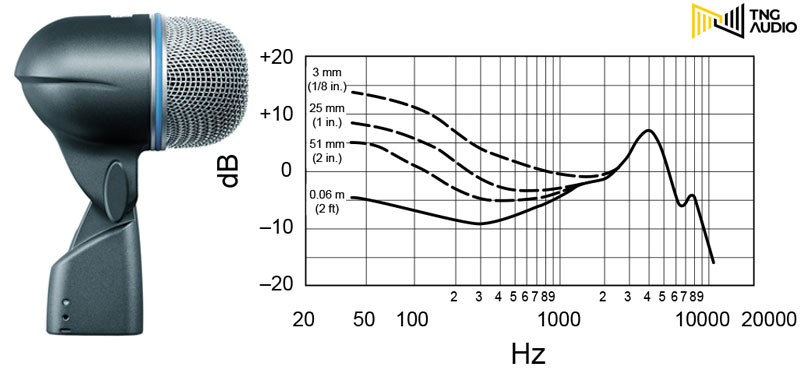
A microphone with peaks or dips at certain frequencies is said to have a 'shaped' response. This response is designed to enhance a frequency range that is specific to a given sound source. For instance, a microphone may have a peak in the 2-10Khz range to enhance the intelligibility or presence of vocals. Another example includes kick drum microphones, which often have an increased bass response, combined with a scooped mid and presence peak. Shaped frequency responses allow us to focus on desirable frequencies for a number of given applications.
 
Phản hồi tần số của micro trống kick Shure Beta 52A
Frequency response chart for Shure Beta 52A kick drum mic
 
 
Also worth considering, is that although dynamic, condenser, and ribbon microphones may have similar published frequency response specifications their sound qualities can be quite different. A primary aspect of this difference is in their transient response. Essentially, condenser and ribbon microphones will typically sound more natural as the diaphragm or ribbon can respond to sound faster, and this results in higher sensitivity, alongside greater high-frequency detail.
 

The Bottom Line


So there you have it; your crash course in microphone transducers, polar-patterns, and frequency response is complete. Mastering the basics at this stage in the signal chain is essential to getting a great end result. If you only take one thing away from this article, it should be that inputs are more important than outputs. Failing to get things right at the start of the signal chain will only result in a headache further down the line. Thankfully, armed with the fundamentals, you can now make a more informed choice to ensure your signal – whether it be for live or studio purposes – gets off on the right foot.
Shure
Tag: Vocals

Blog Related Article

Home Recording Guide for Beginners: Equipment, Setup, Boom Arms and More
14 Feb

Home Recording Guide for Beginners: Equipment, Setup, Boom Arms and More

Recording at home is convenient, but how do you get started? Our guide tells you everything you need to know, plus some pro hacks.  

Recording at home is convenient, but how do you get started? Our guide tells you everything you need to know, plus some pro hacks.   Everyone records at home these days, from the aspiring producer with 10 followers to successful artists with 10 million fans. But if you’ve neve...

Read More
Choosing the Right Mic
29 Aug

Choosing the Right Mic

This post explains what to look for in mics for different applications so you can outfit your band appropriately. Product suggestions from value

This post explains what to look for in mics for different applications so you can outfit your band appropriately. Product suggestions from value-priced to feature-rich are included. "Which Shure microphone is best for me?" is one of the most common questions our product support te...

Read More
Which microphone should I use on ... ? (Selection Guides)
29 Aug

Which microphone should I use on ... ? (Selection Guides)

The following are current Shure microphones as of March 2021.         Vocals Li

The following are current Shure microphones as of March 2021.         Vocals Live Vocals KSM8 KSM9 KSM11 Nexadyne 8/C Nexadyne 8/S Beta 58A SM58 Beta 87A Beta 87C SM86 S...

Read More


  • Warranty Policy
  • Return Policy
  • Ordering process
  • Privacy Policy
  • fa fa-map-marker 198 Dien Bien Phu Street, Xuan Hoa Ward, Ho Chi Minh City
  • fa fa-phone 0945 418 118 - 0942 078 580
  • zalo 0945 418 118 - 0942 078 580
  • fa fa-envelope info@tng.com.vn
  • facebook TNG Audio Shop
  • fa fa-instagram Tiếng Ngọc Audio
  • fa fa-youtube Tiếng Ngọc Audio
  • fa fa-globe www.TNG.com.vn

Brands

Shure
Onkyo
Mission
Pioneer
FOS
dBTechnologies
ANT

Product

Home Audio
Stage Audio
Conferencing & Meeting
Conferencing & Meeting Microphones
Micro Biểu Diễn
Loa Gia Đình
Loa Sân Khấu
Amply & Đầu DVD/CD
Tai Nghe
  • facebookFacebook
  • instagramInstagram
  • youtubeYoutube
  • phone Phone
  • zalo Zalo
Show More Show Less
© 2026 Tiếng Ngọc Audio. All Rights Reserved.
  • Recruitment
  • About us
  • Contact
  • Term Service
  • Privacy & Cookies

Added to cart successfully.